











The Spare Room That Changed an Industry
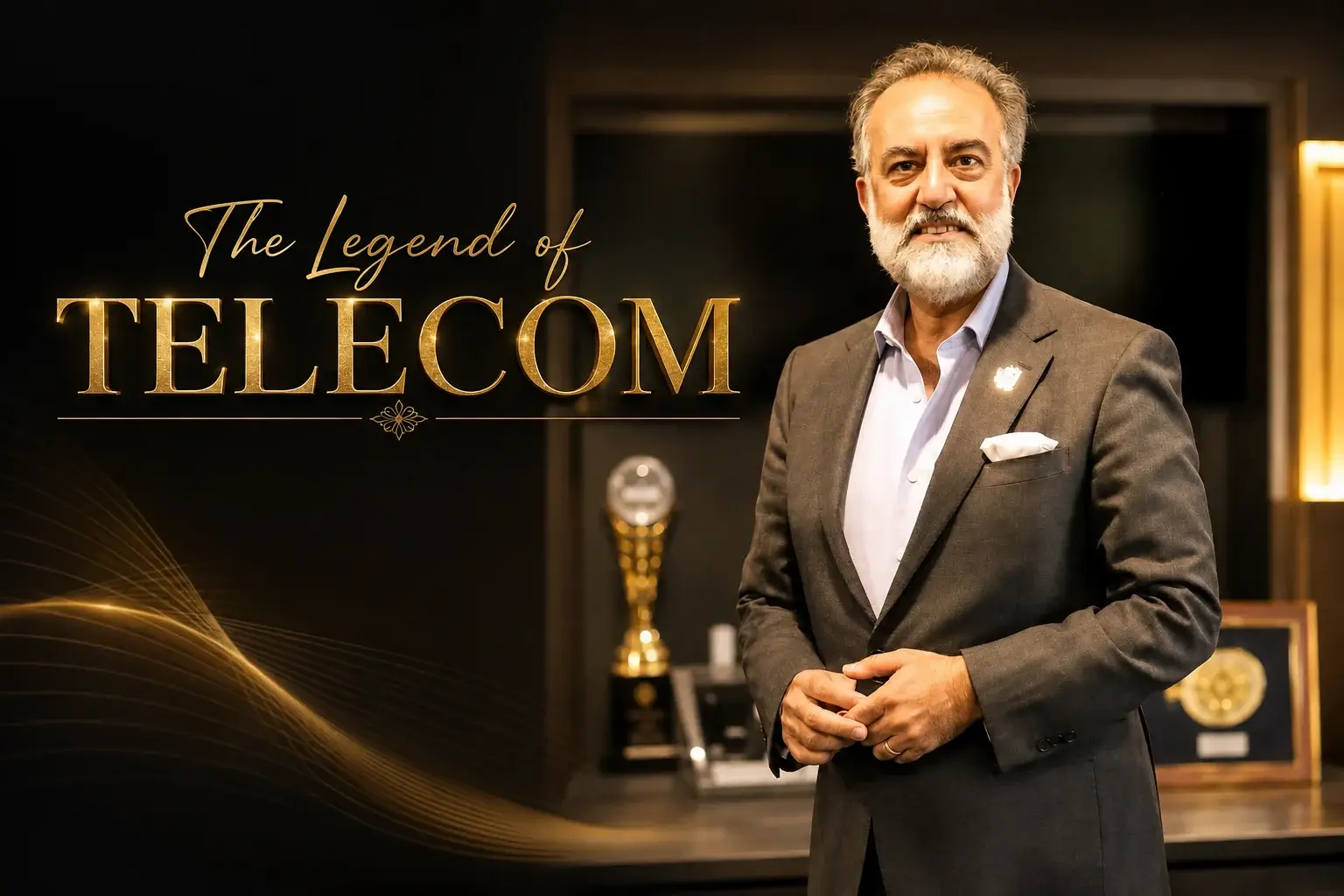
In 1993, Karachi wasn’t known for telecommunications ambition. Pakistan’s connectivity infrastructure was fragmented, expensive, and inaccessible to most citizens. Yet in a modest spare room, a young chartered accountant named Zouhair Abdul Khaliq carried a conviction that would reshape the nation’s digital future: Pakistan deserved world-class connectivity.
No venture capital. No corporate playbook. No billion-dollar backing.
Just a desk, a vision, and an unflinching willingness to do what others wouldn’t.
That spare room became Mobilink—and within three decades, it transformed from a startup with a single borrowed dollar into Pakistan’s largest private-sector company, eventually serving 32 million customers across the nation.
But Zouhair’s story is more than a telecom success. It’s a masterclass in sustainable entrepreneurship, resilient leadership, and the kind of long-term thinking that aligns perfectly with the UN’s Sustainable Development Goals.
The First Lesson: Start With What You Have
When Motorola recruited Zouhair as their first employee and CFO in 1993, they gave him something rarer than capital: responsibility without guarantee. His mission was to raise funds for a Pakistani telecom venture from banks sceptical of the market and wary of political instability.
Most people would have waited for a safer bet.
Zouhair didn’t.
He knocked on doors. He built relationships. He secured the first loan—USD 15 million from Citibank—by demonstrating something that transcends business plans: credibility born from showing up.
The SDG Connection: This reflects SDG 8 (Decent Work and Economic Growth) and SDG 9 (Industry, Innovation and Infrastructure). Zouhair didn’t wait for perfect conditions or massive funding. He demonstrated that sustainable economic growth in emerging markets doesn’t require Silicon Valley billions—it requires leadership willing to build from first principles.
The Difficult Season: When Leaders Run Toward the Fire
A decade into Mobilink’s success, the company stumbled. Pakistan’s telecom market was increasingly competitive. The organisation that had scaled explosively was struggling to adapt.
Here’s where most leaders would have stayed retired.
Instead, Zouhair returned—not as a victor surveying his kingdom, but as a fixer willing to do the work that needed doing.
In 3.5 years, he took Mobilink from 1 million to 32 million customers. Revenue grew from “paltry” to $1.4 billion. More importantly, he restored profitability and institutional credibility during a period when many thought the company’s window had closed.
What strikes observers isn’t the scale of growth—it’s his approach. Zouhair didn’t become a distant executive. He:
- Climbed cellular towers despite a fear of heights to understand operational realities
- Walked Cairo’s streets to observe how different markets operated
- Launched networks in post-conflict Iraq when most companies were retreating to safety
- Built JazzCash years before “fintech” became fashionable, creating financial services for unbanked populations
The Leadership Philosophy: Zouhair’s willingness to personally engage with operational reality—to climb towers, to travel to unstable regions, to understand customer problems from ground level—reveals something critical about sustainable business: True leadership isn’t delegation from above. It’s engagement from within.
The SDG Connection: This is SDG 9 (Infrastructure) and SDG 10 (Reduced Inequalities) in practice. By expanding telecom infrastructure into underserved markets like Iraq and creating JazzCash for the unbanked, Zouhair wasn’t just building business—he was closing the digital divide. He was providing infrastructure that enables economic participation for populations previously locked out of formal financial systems.
JazzCash: Entrepreneurship Before There Was a Name For It
While Silicon Valley was still figuring out what “mobile money” meant, Zouhair and his team launched JazzCash—a mobile financial services platform that allowed millions of Pakistanis without bank accounts to participate in formal commerce.
This wasn’t celebrated as a startup success story at the time. It was viewed as an ancillary product for a telecom company.
Today, it’s recognised as a pioneering financial inclusion initiative that directly supported SDG 1 (No Poverty), SDG 5 (Gender Equality—especially in enabling financial independence for women), and SDG 8 (Economic Growth).
Zouhair built it not because venture capitalists were chasing the opportunity, but because he saw a market need and the infrastructure to address it.
The Ecosystem Builder: NIC Islamabad and the Startup Paradox
Perhaps most revealing of Zouhair’s philosophy is his support for the National Incubation Centre (NIC) Islamabad, where he backed over 300 startups.
When asked why, he reportedly said: “Pakistan doesn’t need unicorns—it needs resilient businesses.”
This single sentence reveals a fundamentally different way of thinking about entrepreneurship and economic development.
Silicon Valley optimises for home runs—that one 100x return that justifies thousands of failures. There’s logic to this in capital-rich markets with deep exit opportunities. But in emerging markets like Pakistan, that approach is often counterproductive.
What sustainable economic growth actually requires is:
- Businesses resilient enough to weather market volatility
- Job creation that’s broad-based, not concentrated in tech unicorns
- Enterprises that serve local needs and build local capacity
The SDG Connection: This is SDG 8 (Decent Work and Economic Growth) understood holistically. Instead of chasing venture-backed startups that consume capital and often relocate their best talent abroad, Zouhair’s philosophy emphasises building a foundation of resilient, locally-rooted businesses. These create sustainable jobs, keep capital circulating within Pakistan’s economy, and develop entrepreneurial capacity across the nation.
The Wisdom That Only Comes From Doing Hard Things
Near the end of a recent fireside chat, Zouhair offered what might be his most revealing insight:
“Never say ‘yeh mera kaam nahi hai.’ That sentence kills more careers than failure ever will.”
(In Urdu, this translates to: “Never say ‘that’s not my job.'”)
This isn’t a motivational platitude. It’s the philosophy of someone who climbed towers despite being afraid of heights. Who walked Cairo’s streets to understand operations. Who returned to a struggling company instead of retiring.
In corporate culture, particularly in hierarchical environments, people advance by defining narrow lanes of responsibility and protecting them fiercely. The accounting department doesn’t fix sales problems. Engineering doesn’t solve supply chain issues.
Zouhair’s career is the opposite. Every significant opportunity in his journey required him to do work that was technically “not his job”—to step outside defined domains and engage with whatever the organisation needed.
The Lesson for Sustainable Business: SDG achievement isn’t a departmental responsibility. Climate goals aren’t the environment team’s problem alone. Poverty reduction isn’t social responsibility’s job. Sustainable development requires leaders who refuse siloed thinking and instead engage holistically with the full ecosystem of challenges and opportunities.
Spare Rooms, Spare Time, and the Building Blocks of Great Things
What’s most striking about Zouhair’s story, particularly in an era of startup mythology and venture capital theatre, is how quietly he built something genuinely transformative.
He didn’t announce himself as a visionary. He didn’t begin with a pitch deck or a Stanford MBA. He started with:
- A problem he noticed (Pakistan’s connectivity gap)
- An opportunity he could access (Motorola’s backing)
- A willingness to do unglamorous work (knocking on bank doors, climbing towers)
The spare room wasn’t temporary—it was foundational. It taught him to build from constraint, to maximize limited resources, to focus ruthlessly on what actually mattered.
That mindset didn’t disappear when Mobilink became massive. In fact, it’s precisely what allowed him to return during a difficult season and restore the company’s trajectory. He approached a billion-dollar organization the way he’d approached the spare room: What actually needs doing? How do I help?
Why Zouhair’s Story Matters for SDGZero’s Mission
SDGZero exists to help small and medium enterprises connect their business with the UN’s Sustainable Development Goals.
Zouhair’s career demonstrates that these goals aren’t abstract targets for government policy or corporate CSR departments. They’re concrete challenges that create business opportunities for leaders willing to:
- See unmet needs (Pakistan’s connectivity gap, unbanked populations’ financial exclusion)
- Build solutions (telecom infrastructure, mobile financial services)
- Remain committed through difficult seasons (returning to Mobilink when it struggled)
- Prioritise sustainable growth over short-term extraction (“resilient businesses, not unicorns”)
- Refuse siloed thinking (“never say that’s not my job”)
An SME founder reading this should recognise that sustainable business doesn’t require venture capital or startup mythology. It requires:
- Clear-eyed assessment of market needs
- Willingness to engage deeply with operational reality
- Commitment to resilience over explosive growth
- Leadership that spans across traditional boundaries
The Fireside Chat and the Unscripted Truth
During a recent conversation with Ali Shah, Zouhair didn’t perform like a man reminiscing about past glory. He spoke like someone still actively thinking about Pakistan’s infrastructure gaps, entrepreneurial potential, and economic resilience.
He spoke like someone who never actually left the spare room—not because he didn’t advance, but because he never stopped thinking like someone building from constraint.
This is the opposite of the typical founder’s journey narrative. There’s no moment where he “made it” and moved on. There’s only deepening engagement with the country’s economic development.
The Harder Path, The Better Destination
In a business environment obsessed with shortcuts—growth hacking, viral loops, aggressive VC scaling—Zouhair’s career represents an older, more durable model of leadership:
Real things are built slowly, with your hands, in difficult seasons, when nobody is watching.
The spare room eventually became an office building. The office building eventually became a company that touched tens of millions of lives. But the philosophy that built it—show up, do the unglamorous work, engage with reality, refuse boundaries—never changed.
For entrepreneurs building sustainable businesses in Pakistan, South Asia, and beyond, that’s worth remembering.
The most transformative companies often begin exactly where Zouhair began: with a desk, a vision, and the willingness to do what others won’t.